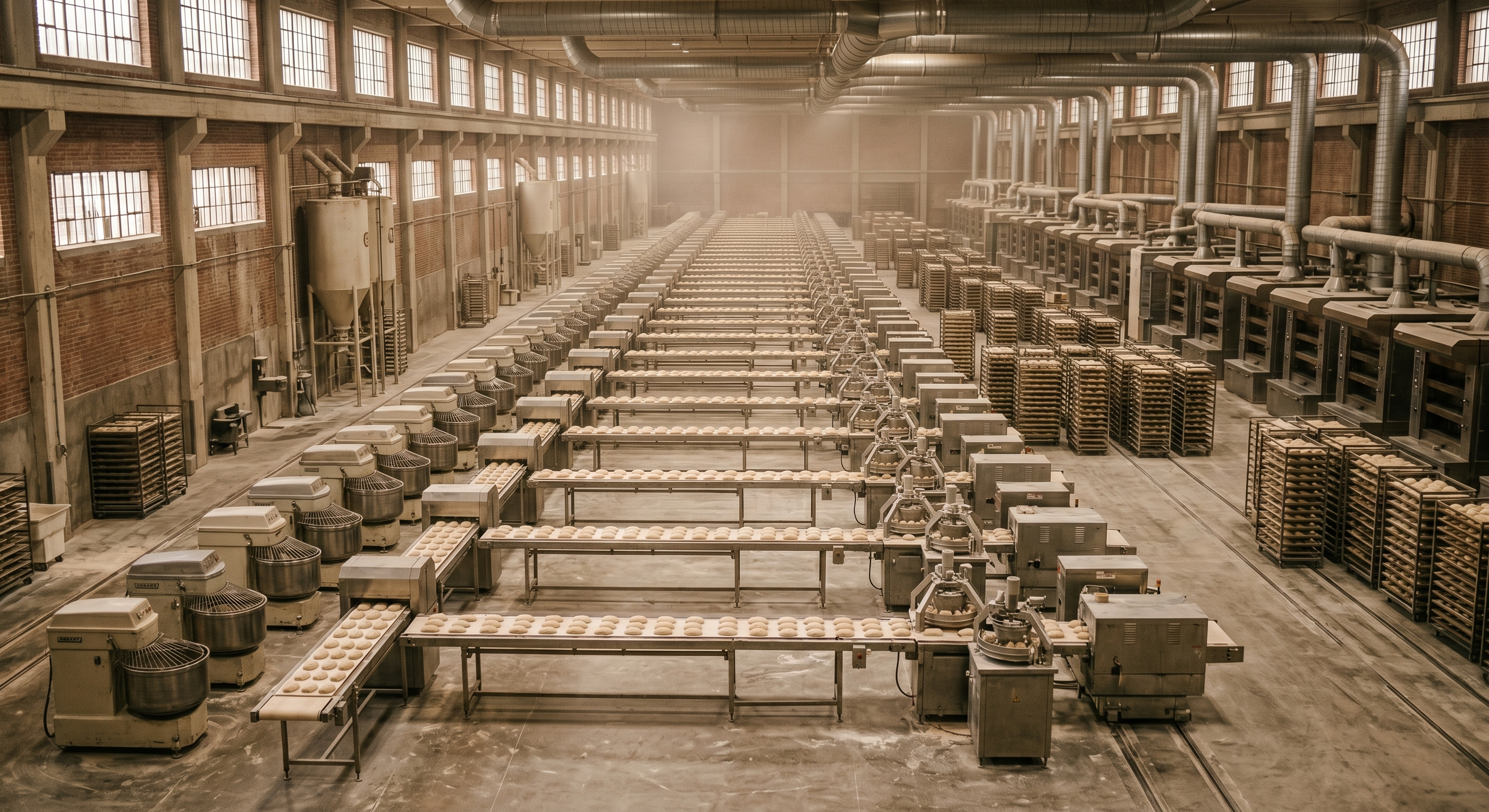
The front of the building assembles finished units from a bill of materials, a route, and a work cell. That is discrete. Halfway back, someone is blending or reacting raw inputs into a batch, and the output is measured by weight or volume, not by each. That is process. And somewhere there is a line that does not want a work order at all — it wants a signal that says "make more now." That is lean.
The chaos shows up when the ERP only believes in one of those realities. We see it constantly during discovery: a process manufacturer who has been forced to model formulas as discrete BOMs because the previous system could not handle a batch, or a discrete shop that tracks lot and shelf life in a spreadsheet because the system treats every item as anonymous and infinite. The workarounds are not the problem. The workarounds are the symptom. The problem is that the data model never matched the plant.
What "mixed-mode" actually means in D365
Dynamics 365 Supply Chain Management supports discrete, process, and lean production in the same instance, and that is the whole point. You are not buying three systems or bolting on a process add-on. You are configuring production control to tell the truth about each item and each line.
In practice that breaks down into a few decisions you make per product, not per company.
Discrete. Bills of materials, routes, operations, and resources. Quantities are counted in eaches. This is the part most ERPs do reasonably well, so it is rarely where the pain lives.
Process. Formulas instead of BOMs, with the things discrete manufacturing does not have: co-products and by-products coming off a single batch, catch-weight items where the unit you stock differs from the unit you sell, batch attributes like potency or grade that drive disposition, and shelf life with expiration and best-before dates. If your output is a batch and your inputs vary in concentration, this is the model you need — and forcing it into a discrete BOM is exactly the workaround that breaks costing later.
Lean. Production flows and kanbans, where replenishment is pulled by demand signals rather than pushed by individual production orders. For a repetitive line, this removes the order-by-order overhead that discrete control imposes and that the operators ignore anyway.
Where the real work is
The licensing and the module support are the easy part. The hard part — and the part worth paying for — is the master data discipline that mixed-mode demands. A few things we flag early on every engagement of this shape:
Production type is a per-item decision
You have to decide, item by item, which production type each product uses, and that decision has consequences you will not unwind cheaply later. It is a discovery conversation with the people who actually run the line, not a config screen you fill in at the end.
One precise note, since the three modes can blur together here: in D365 the Production type field itself is BOM, Formula, Co-product, By-product, or Planning item. Discrete items are BOM; process items must be Formula, with co-products and by-products as their own types. Lean is not a value in that field at all — it is a supply and replenishment model layered onto a BOM item through production flows and kanban rules. Microsoft's guidance for mixed-mode flexibility is to use BOM production types wherever you can and then choose how each item is supplied — production orders, kanbans, transfer orders, or purchase orders — reserving the process production types for true formula-based output.
Catch-weight is a commitment
Once an item is catch-weight enabled, it touches sales, purchasing, warehouse, and costing. It is powerful and it is correct for variable-weight goods, and it is also not something you toggle on casually mid-project.
Co-products force a costing answer
Co-products and by-products force you to answer a costing question you may have been avoiding: when one batch yields three sellable outputs, how is cost allocated across them? D365 will do it, but it will do whatever you tell it — so someone with a finance seat at the table has to own that answer.
Batch and shelf life live in the warehouse
Batch disposition and shelf life only work if the warehouse processes feed them real dates and statuses. The configuration is the start, not the finish. The handheld scans and the operator behavior are what keep batch attributes meaningful six months after go-live.
What we would tell you on day one
If you run more than one kind of manufacturing under one roof, do not pick the ERP that is strongest at your biggest mode and plan to work around the rest. The workarounds are where the cost and the bad data accumulate, quietly, until a physical count or an audit makes them loud.
Map each product to its real production type before you touch configuration. Get a finance owner on the co-product and catch-weight decisions early. Treat batch and shelf-life setup as a warehouse-process problem, not just a master-data problem. D365 Supply Chain Management can hold all three modes honestly in one instance, which is rare and genuinely useful. Whether it does depends almost entirely on how disciplined you are about the model before you go live.
Frequently asked questions
Can Dynamics 365 run discrete, process, and lean manufacturing in one instance?
Yes. D365 Supply Chain Management supports discrete, process, and lean production in the same instance and the same legal entity. You set the production type per item rather than buying separate systems or bolting on a process add-on, so all three modes roll up to one set of books.
What is mixed-mode manufacturing?
Mixed-mode manufacturing is when a single plant or company runs more than one production method at once — typically discrete (assembling counted units from a BOM and route), process (blending or reacting inputs into a measured batch), and lean (replenishment pulled by demand signals via kanban). The challenge is modeling all three honestly in one ERP.
Why shouldn't you model a process batch as a discrete BOM?
Forcing a batch into a discrete BOM breaks costing and inventory. Your standard cost rolls up wrong, co-product and by-product cost allocation has nowhere to live, and on-hand for the by-product simply does not exist. Master planning, costing, and inventory valuation all read from the production model, so the accounting is only as honest as the production setup.
What is catch-weight, and when do you need it?
Catch-weight is for variable-weight goods where the unit you stock differs from the unit you sell — common in food, meat, and chemicals. It is correct and powerful for those items, but enabling it touches sales, purchasing, warehouse, and costing, so it is a project-level commitment, not a switch you flip casually mid-project.
How does D365 allocate cost across co-products from one batch?
D365 will allocate cost across co-products however you configure it — by weight, by sales value, or by a fixed factor. Because it does whatever you tell it, someone with a finance seat at the table has to own the allocation rule when one batch yields several sellable outputs. It is a costing decision, not just a configuration step.
Caf2Code is a Microsoft Solutions Partner specializing in Dynamics 365 Finance and Supply Chain Management. If you are weighing a mixed-mode implementation, we are happy to walk your floor and tell you what we see.